Dear Ms. Suleik,
I read with great interest, and sadness, your observations regarding the Catholic Church today which I have also observed. I believe some devout Catholics feel the same way in their hearts but at the same time feel a little helpless with the existing situation. All is not lost, however. There is a “minority” within the Catholic Church that adheres to the traditional way of doing the mass as envisioned by Pope Benedict XVI: solemn, reverential, celestial.
Early last year, a trans-parochial group of parishioners approached the Parish Priest of St. Jerome Emiliani Parish in Alabang to request for the Traditional Latin Mass according to the 1962 missal. The Italian parish priest, Fr. Grato Germanetto CRS consented to the request in accordance with the Motu Propio of Pope Benedict XVI and informed his Bishop of his decision. June 29, 2008 saw the first Traditional Latin High Mass to be celebrated at St. Jerome to a large audience. It has been six months already and we are still growing in numbers every Sunday.
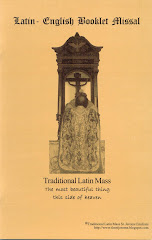
While I don't have any personal recollection of the traditional Latin Mass in my childhood, I discovered the rich tradition and beauty of the liturgy of Traditional Latin Mass. The ancient prayers are so profound, so beautiful and mysterious at the same time! I wondered why they shortened it so much in the New Mass (Novus Ordo). Boy, they are missing a lot! I’ve since learned how to follow the Mass sequence via the Latin-English missalette. I love watching the genuflections, the acts of reverence, the torch processions of altar servers, the ritual of the changing of the books from the Epistle to the Gospel side, the incensing, the beautiful Gregorian chant in four voices sung by a male choir (schola), listening and learning how to pronounce Latin, the silence. It's very uplifting, edifying. I feel my faith growing deeper with this kind of Mass.
There is so much to experience that I look forward to it every Sunday. Everyone inside the church is nearly quiet (except for small children) and the silence is heaven! People are busy praying or reading from their missal, or just simply watching what is going on in the altar. Oh, and I wear a dress (skirt) and a veil although not everyone does but there are quite a number of us who do and it's obvious who are the walk-ins or first timers by the way they dress. And the best part? We receive communion kneeling down and on the tongue. No one complains.
Six months ago, we (organizers) printed 500 copies of the missalette (Latin-English) and we are down to 24 copies and are re-printing another 500 copies. That's just to show you how interested devout Catholics are. TLM may not be for everyone yet but there is a growing number of Catholics who yearn for this kind of reverence, silence, and traditional liturgy. Truly, the Traditional Latin Mass is the “pambato” of the Catholic Church against the other churches like the Protestant because it has something they don’t have. Tradition as old as 2,000 years.
We invite you to come and experience the Traditional Latin Mass which happens every Sunday at 9:30 am at St. Jerome Parish in Alabang (except on Feb. 8 as it is the feast of the parish and so the Latin mass has to give way) and see for yourself that there is hope. There is hope because a group of parishioners aimed to make a difference and not wait for the Church to do its job. It's a lot of hard work and sacrifice but definitely worth it.
Thank you for your time and I hope many Catholics wake up to the real situation of the Catholic church today.
Sincerely,
Mary Elaine Friend
TLM St. Jerome Emiliani
Organizing Committee, Treasurer